
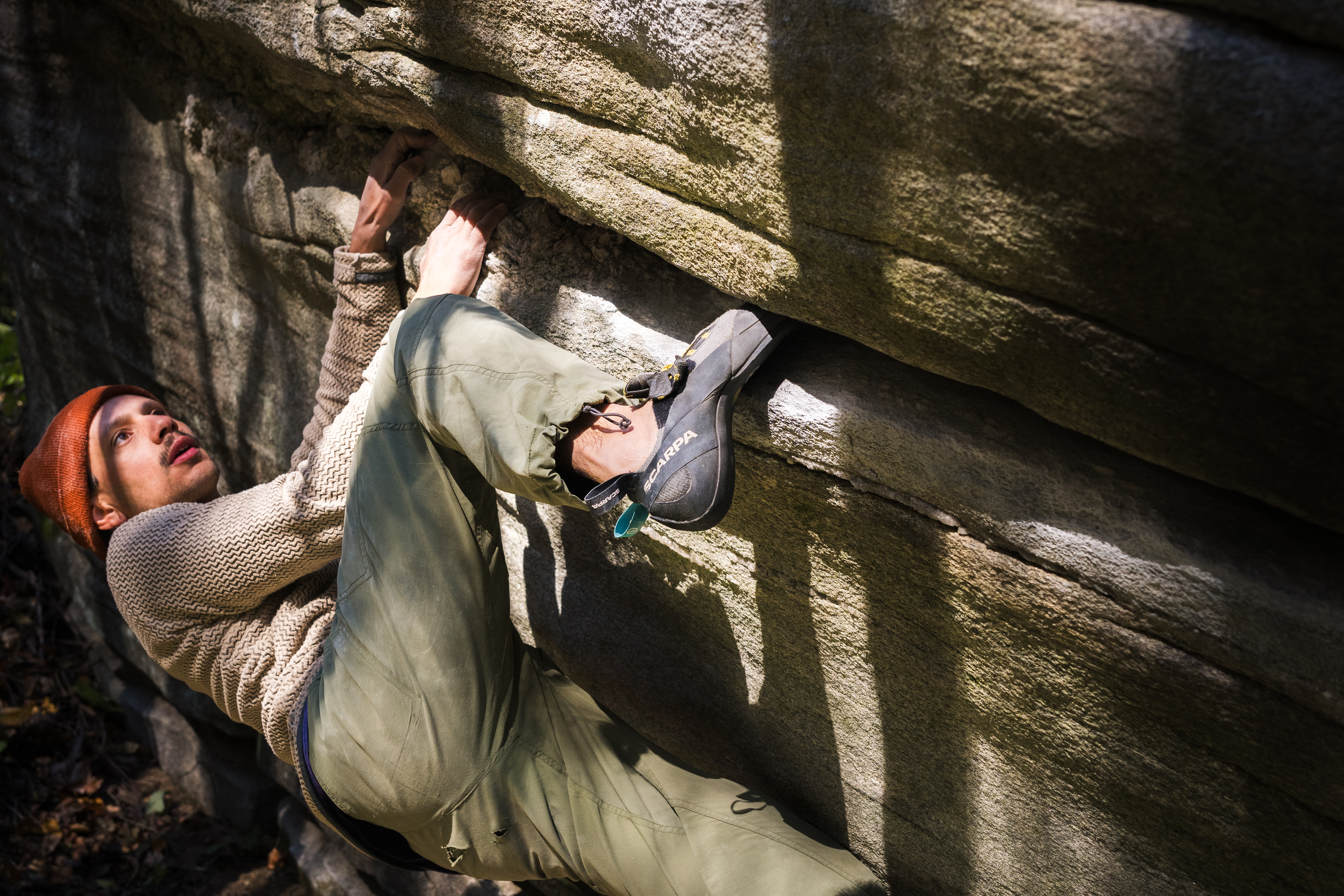

The Purpose of Climbing Shoes
Rock climbing shoes are arguably one of the most important tools in a climber’s toolbox! Climbing shoes allow us to stand on micro edges, smear on the most improbable blank faces, and jam our feet into small or large cracks. They enable our toes to act as a singular unit, making it easier to do these movements on repeat for an entire pitch or even an entire wall! Climbing shoes are meant to help us climb more efficiently using their sticky rubber sole on all types of rock terrain.
Climbing Shoes vs. Approach Shoes
Approach shoes are, in fact, climbing shoes, but they serve a specific purpose. An approach shoe is a hiking shoe that employs a few climbing shoe tricks, such as sticky rubber and a narrower toe box for more precise footwork. These shoes are great for approaches that require some scrambling or even just hikes on rocky terrain. One might even go as far as climbing 5th-class terrain in them, depending on the shoe and the level of climbing ability they have. An advanced climber might choose an approach shoe over a climbing shoe due to the comfort difference and the fact that they can leave the same shoe on for the climb as the hike.
Types of Climbing Shoes
Climbing shoes can be broken down into three main types: flat, moderate, and aggressive.
Flat Climbing Shoes: When I say flat, I am referring to the shape of the sole when worn on the foot. The sole on flat shoes has no downturn, allows the foot to bend, and is generally more comfortable, sacrificing a bit of performance in favor of comfort. Flat shoes are great for beginners or folks looking for a shoe they can wear for extended periods.
Moderate Climbing Shoes: Moderate shoes are the next step up for performance. Moderate climbing shoes have a slight downturn and often a slight point in the toe, making them much more powerful and precise on small edges. Moderate shoes are great all-around shoes and are the ones I grab the most often.
Aggressive Climbing Shoes: Aggressive climbing shoes are the most powerful and precise of the three types. With a very downturned and pointy toe, these shoes are for steep climbing or climbing that requires precise footwork on overhanging holds. The powerful toe on this type of shoe is a game changer when the climbing gets steep, allowing you to toe in on the smallest overhanging edges.
How to Fit Your Climbing Shoes
Finding the right fit for your climbing shoes is essential to their performance. With so many different climbing shoes on the market, it’s best to read the manufacturer’s recommendation on how to fit their shoe.
You may often hear folks say if the shoe doesn’t hurt, it’s too big. Fortunately, this is simply not true anymore. However, they shouldn’t fit like your Hoka One One’s either. If you can comfortably walk around in them without wanting to take them off, they might be a bit oversized. The idea is that the shoe fits like a well-formed glove with no extra space at all. This allows the shoe to do its job and give your foot support. I always recommend trying on climbing shoes before you buy to get the exact fit you are looking for. Higher-end climbing shoes are made by hand and can have some slight discrepancies in fit.

Caring for Your Climbing Shoes
Taking care of your climbing shoes goes a long way in helping them to last, perform, and stay sticky. Something I often say is, “Climbing shoes are made for climbing, and walking shoes are made for walking.” All I mean by this is that climbing shoes are designed for climbing rock, not walking around in the dirt. Climbing shoe rubber is exceptionally soft, and the more you walk around in dirt and grit, the faster you’ll wear them out. Three simple rules to take good care of your climbing shoes are: only wear them while climbing, let them air out, and give them a hand wash every so often.
My Top Recommendations
My top picks for beginner climbing shoes are the Tarantulace from La Sportiva and the Helix from Scarpa.
My top picks for trad climbing are the Scarpa Vapor line, the TC Pro, and Katana from La Sportiva.
My top picks for gym climbing are the Scarpa Vapor S, Scarpa Instinct, La Sportiva Solution Comp.
Frequently Asked Questions
Are climbing shoes supposed to hurt?
Your climbing shoes shouldn’t hurt, but they should fit very snugly. It should be the kind of fit that you wouldn’t want to wear for very long or walk around in.
Will climbing shoes stretch?
It depends on the shoe. Some shoes are made of unlined leather. These can stretch up to a full size. However, shoes that are made of fully synthetic or synthetic-lined leather will not stretch.
Where can I buy climbing shoes in Asheville, NC?
Here in the Asheville area, you can find a great collection of climbing shoes at Black Dome Mountain Sports. We also have an REI location with a climbing section as well. Whenever possible, it’s always a good idea to try on a pair of climbing shoes at a store before you buy, as each brand may have slight differences in sizing.
What is resoling?
Climbing shoe resoling is when you have worn out the sole on your climbing shoe and replace it with a new one. This preserves the life of your expensive climbing shoes and saves you the break-in period once you get them back. I highly recommend resoling your shoes at least 1-2 times. Climbing shoes are about $200 new, and a resole can run you less than $60.
Can climbing shoes get wet?
Yes, it’s not a big deal if they get wet. Although, it can make them very slick if you climb in them while they are wet.
Can climbing shoes be washed?
Yes, some manufacturers recommend you wash your climbing shoes. Simply clean with a soft brush and light soap, and let air dry. Make sure to avoid machine washing them!
Which climbing shoes are best for wide feet?
Many manufacturers have what they call a low-volume version of their climbing shoes. Often, this will be represented as “women’s” or will be labeled LV for “Low Volume.” Low-volume shoes are thinner, so if you’re looking for a wider version, you’ll often find the “men’s” shoes to be a higher volume. Most manufacturers also offer a shoe or two specifically in wide sizes, and lace-up climbing shoes offer more adjustability.
Do you wear climbing shoes with socks on?
No, and yes. Typically, a climbing shoe is sized to fit without socks to allow maximum sensitivity and no extra space in the shoe. Although, there are a few reasons one could argue to wear climbing shoes with socks. If your shoes give you hot spots or blisters, you may want to wear thin socks, or in the winter, some folks consider sizing their shoes bigger to allow socks for insulation.